I have created an app, usable on both Apple and Android, phones and tablets, specifically for ADHD and ASD children, but may be used by all children, to train time awareness and improve self-regulation. It is free to download (from iTunes and Google Play). The app is called Klokk: The Time Trainer.
Executive Version: Main Instructions
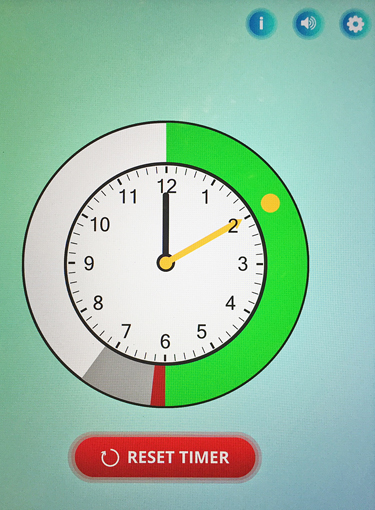
The purpose of the Klokk is to train children to monitor time, such as taking a turn playing a video game, with the aim of ending the activity without distress. It does this by setting a time frame on a clock, and then training them to count down to the end of the time period.
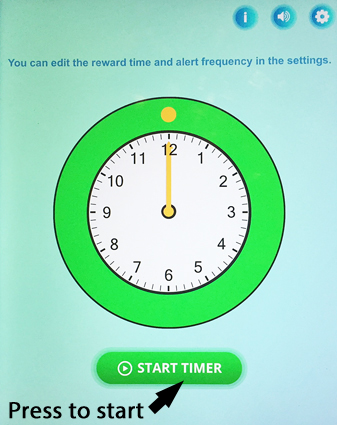
The screen opens ….
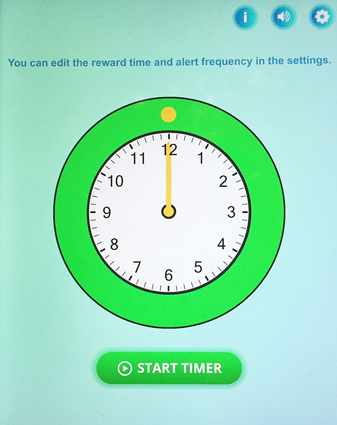
In the top right corner are control buttons …

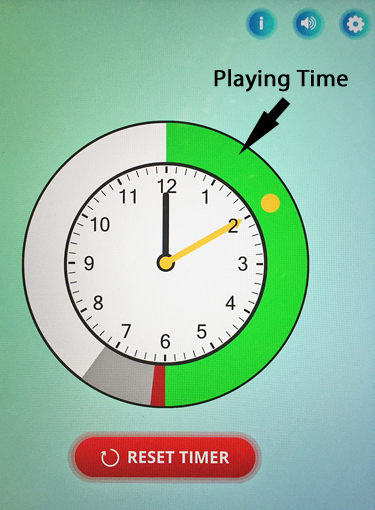
#1. The playing time (in green) is programmable: the default is set at 30 minutes. It can be re-set for any amount of time up to 60 minutes on the clock. If longer periods are needed, then only set the last 30 minutes.
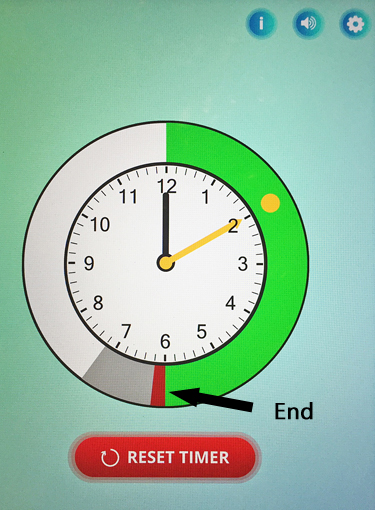
#2. There is a reward time (in grey) where the child is rewarded with extra time for stating that their turn is up (at the red line on the clock). They can either continue playing, or bank the time for a later date. The default reward time is 5 minutes. This is programmable, and may be set for longer periods.

#3. There is a sound cue to alert the child to look at the clock at set intervals. This is central to anticipating that time is passing, and is the main learning factor in developing tolerance or self-regulation for disappointment. The default for the sound cue is 10 minutes. Young children may benefit from less time (e.g. 5 minutes). As the child becomes adept at monitoring their time on the Klokk, the sound cue can be increased until it is phased out.
Let’s start the clock running!
Quick Start: simply press “start timer” ….
This box will appear with the duration default of 30 minutes.
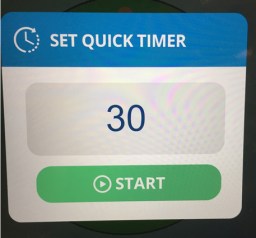
Press “start” and all defaults will operate, and the timer begins immediately. …
If you wish to change the time duration, press the time (“30”) and the keyboard will come up.
Again, once you press “Start”, you are off and time is running!
Begin again?
Restart Timer: Press ”Reset Timer” if you wish to restart the Klokk.
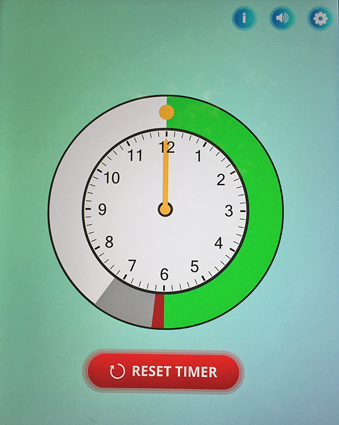
Change the settings?
Set alternate times: Press the “wheel” in the top right-hand corner of the screen. The controls for the Sound Cue and Reward duration are here.
Long Version: Background
I began working with children with ADHD about 30 years ago. It soon became apparent that one of the features identified by Russell Barkley, a disorder of time awareness, was significantly impacting these children. Their lack of time management was all-pervasive. I used to joke to audiences at the seminars and talks I gave that I could diagnose an ADHD child in 3 seconds flat – all I had to do was look at their wrist … they did not wear a watch. When they did, it was a digital timepiece, since they liked pushing the buttons and setting alarms. A watch was just a toy. Of course, that was about 25 years ago … fast forward to today and few children and adolescents wear watches, and when they do it is a Fitbit, or they carry a pocket watch (iPhone) … and these are digital as well. What is relevant about this? Well, you cannot monitor time with a digital display. Digital is great for telling the time, but it does not display time frames. Only analogue time can do this.
Time frames are a shape … we all know what 15 minutes looks like …

… and what 30 minutes looks like …

You cannot do this with a digital display – unless you are capable of visualising analogue from digital. However, children with ADHD struggle with this skill. The ability to visualise time is a central component in being able to forward plan and multitask.
Almost all, if not all, the ADHD children I’ve assessed over the decades demonstrate not just difficulties with working memory, but specifically a difficulty with visual working memory. Visual working memory is the building block for forward planning: I could ask, “how do you know what you are going to do later today?” I would hope that you can “visualise” yourself doing the things you have planned … and visualise the time set aside for it … a time to begin and a time to end (because there is a need to anticipate what follows). Please note my emphasis that a time frame has a beginning and an end.
Time frames, where the child cannot see where time began, makes it harder to accept that they have had their full time. It increases stress and tension as they feel short-changed.
Why there is temper when asked to end an activity
Work with ADHD enough and you know that it is not simply about Inattention or Hyperactivity. Those are problem areas, but specifically they are categories based on behavioural descriptions.
ADHD is instead a combination of disorganisation and emotional dysregulation. Disorganisation refers to the difficulty such children (and adults) have with forward planning, that is, a poor ability to anticipate and visualise a future event. As a result, there is surprise and a sense of being overwhelmed by ongoing events as they are unexpected. Without visualised forward planning, there can be no anticipation of consequences. Emotional dysregulation refers to the lower threshold for emotions that these children have. They simply cannot deal with the same level of stress, or excitement, that other children can, and react sooner. When disappointed, such as when surprised that their video game time is over – prematurely in their perception – they act out their emotions in a predictably negative way (such as arguing, debating, and even lashing out or being destructive). The children feel ripped off.
Over the many years of my private practice I have taught thousands of parents how to modify a standard wall clock to aid in teaching their children to monitor time. The concept works very well. More recently I recognised that parents were turning to electronic devices to aid in this regard. My concerns grew when it became apparent that this often involves a digital device (such as a cell phone or, worse still, the kitchen timer). I know from experience that these do not teach children anything at all, as these devices do not show that time is passing. As a result, I decided to take my concept of a clock timer and create an app. This became the Klokk.
The real purpose behind monitoring time
The ability to monitor by visualising the passing of time enables the child to accept when time finally passes. Time is a passage and a journey. Time does not occur in isolation – it is a position along a path that has a beginning and an end. I refer to the process of monitoring time running out as “mourning the loss of time”.
In my attempt to understand the meaning of time passing and how it relates to emotional self-regulation, I was reminded of the 5 stages of grief, as outlined by Elisabeth Kübler-Ross, the Swiss-American psychiatrist, and author of the ground-breaking book On Death and Dying.
Consider the child being told to end playing a video game, my re-conception of these stages is:
(1) Denial – “It can’t be time yet!”
(2) Bargaining – “I need 5 more minutes … I need to get to the end of this level!”.
(3) Depression and despair – “It’s not fair. No one else has to stop”.
(4) Anger – feeling ripped off and wanting to lash out at the one who is in control.
(5) Acceptance – coming to terms with the situation, and stopping willingly.
The aim of monitoring time is to keep a check on where we are along the path of our journey. This process starts at the beginning of the journey – not near the end (The classic, “You’ve got 5 minutes to end!”). At that stage, there is too little time left to mourn. In any event, the ADHD (and very young) child has no conception of what 5 minutes looks like. As a result. reaching the stage of acceptance is not possible; and the child is instead stuck in the stage of anger and despair. It often ends in a rage and a tantrum.
Another way to conceptualise this whole process is that it is a process of self-regulation. To put it bluntly, it enables us to accept the inevitable … which makes it easier to suck it up.
Traps, obstacles and a strategy
ADHD children are very single-minded in their pursuit of an interest. They hyperfocus and ignore everything else in the world! Playing a video game is the only thing that exists for them at that moment in time …. and the upshot of this is that there is a strong likelihood that they will become totally unaware of the existence of a clock or timer (even though it is placed alongside the laptop screen), or a parent calling out from another room.
The danger now is that parents will keep reminding the child to “watch the clock”. The consequence of this is eventually disastrous. Children who are disorganised or highly single-minded end up being nagged all the time. This impacts on their self-esteem and they come to see others as persecutors and themselves as not-ok. They end up becoming over-sensitive to criticism.
The question then is how do the parents help the child to watch time passing and still retain their self-esteem by feeling in control? How can we help the child believe that it was they who was successful, and not another for prompting them?
The answer lies in how a prompt is delivered. To directly tell a child what to do can become a negative act. Better to do this indirectly, in a way they are unaware or do not attribute to a parent. For this reason, the Klokk has a sound cue, which can be programmed to appear on a regular basis, and which will cause the child to glance in the direction of the Klokk. The wonder that is analogue is that you do not need to tell the time, just be aware of the hand moving. The frequency of this sound cue can be chosen, or left out altogether. It needs to be closer together (e.g. every 5 minutes) for very young children or those that are highly distracted and more likely to hyperfocus on the screen. The frequency the sound cue can be reduced as the child learns to check the passing of time. I recommend that it be set for at least 10 minutes for most children starting out.
Time frames
A time frame is simply the shape of time. The ability to visualise this, and then monitor the passing of time mentally, is the essence of forward planning and a foundation skill for self-regulation of disappointment. It also becomes a central component of motivating oneself to do tasks of low interest. (Much of what we consider to be motivation is really the ability to suck it up. Delayed rewards do not inspire ADHD children because they cannot visualise when the reward will materialise. Attempting to “motivate” an ADHD child by reward to do an uninteresting task is a recipe in futility … unless one also teaches them the self-regulation of how to wait.
The Klokk is geared towards training a child to visual time frames.
The advantage of analogue time is that it is quick to understand (just glance at the position of the minute hand), and the shape of time is possible to generalise to real life situations on real life analogue watches. This is a reason why the Klokk is also referred to as The Time Trainer. Generalisation of training is critical for real change.
The Reward
In the Klokk, the reward is extra time. A reward at the end of time removes some of the disappointment in time ending. The child is told, “tell me when your time is up – when the hand is on the red line”. And … “If you tell us on time, you get a reward of extra time. You can then continue playing until the end of the reward time”.
This reward has two main objectives: firstly, it takes the sting out of having to end the activity. The child is more willing to track time on the clock, knowing that they will not have to actually end the turn at the red line. Secondly, the continued use of extra time for the reward(s) further reinforces the awareness of the time frame as a concept, and trains their visualisation of the time frame shapes.
I encourage a second reward for alerting the parent that the reward time is completed, this being another 5- or 10-minute time segment. On this occasion it is saved for a later date, such as the weekend, when all time saved may be cashed in. Draw up a paper clock (sliced pizza), and the child can colour in each 5-minute segment, as earned.
Other applications
There are a number of other applications for the Klokk, which will be added to the website in time. These include learning to take turns in games, accepting a time frame for school homework, monitoring time to answer a test in a classroom, accepting chores … amongst a number of others.
Best regards
Derek Cohen Clinical Psychologist
May 2019
 Derek Cohen Clinical Psychologist